Secondary 2 Science takes Biology, Chemistry, and Physics further. The demands on students at this stage are expected to handle more than content recall. Students must think critically, connect ideas across subjects, and apply concepts to new questions.
At our Science tuition centre, we use our Meta-Cognitive Learning Approach to teach students how to process information, identify flaws in their reasoning, and fix those issues before they become habits.
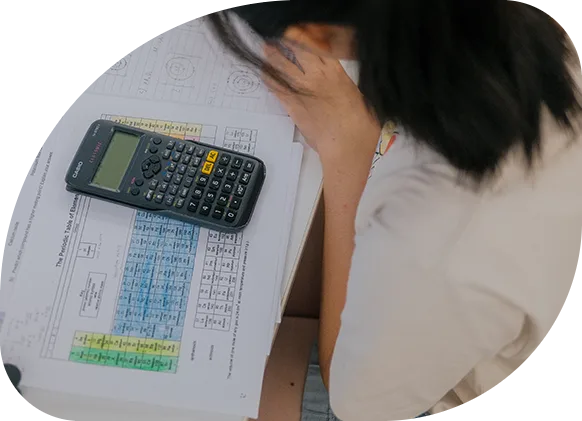
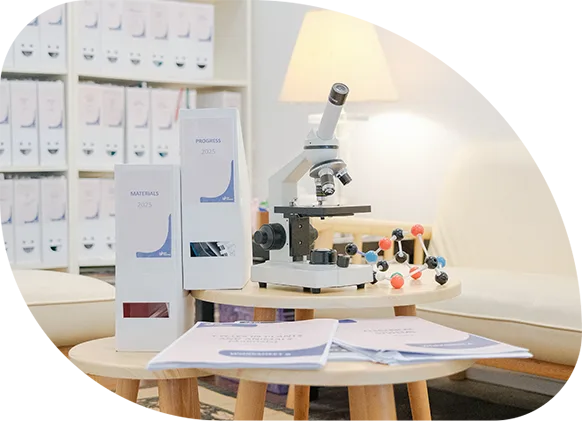
We also identify your child’s learning style, their current gaps, and the key topics in the syllabus. This way, every lesson focuses on where it will have the biggest impact.
When your child joins our secondary 2 Science tuition, they can expect to:
Secondary 2 Science builds on the concepts introduced in Secondary 1, but with more challenges in both content and expectations. Students are expected to apply concepts, analyse information, and explain their reasoning clearly which is where many start to struggle, even those who performed well the previous year.
Unlike in Secondary 1, memorising definitions is no longer enough. Secondary 2 questions require students to take what they know and apply it to problems they have never seen before.
Students are introduced to a wider range of topics across all three Science disciplines. Without a system for organising and revising content, the workload can quickly feel overwhelming.
Secondary 2 is an important year for subject selection. Gaps in key Science topics, especially in Chemistry and Physics, can make it harder to keep up with more advanced concepts later on.
Building a strong foundation in Secondary 2 helps students enter upper secondary Science with confidence.
Our teaching approach helps students to think critically, apply concepts, and learn more effectively.

Secondary 2 students organise key concepts, definitions, and processes from Biology, Chemistry, and Physics into a clear mental framework, so they can retrieve the right information quickly during Science exams.
Students are guided to break down how questions are framed such as reading graphs, unpacking scenarios, and identifying exactly what is being tested, so they answer what is asked, not what they expect.
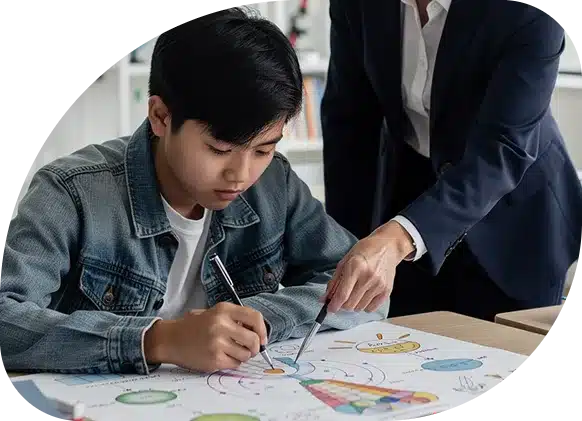
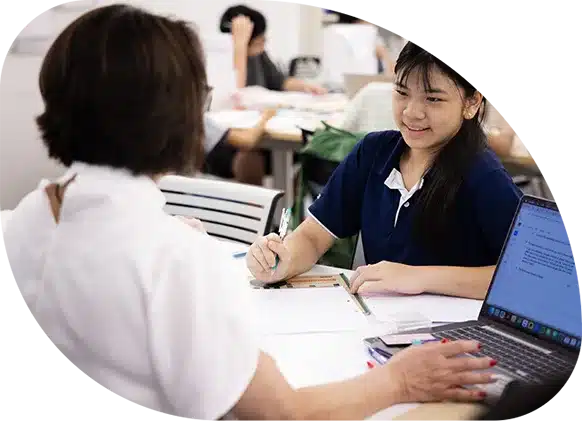
Students learn to construct complete answers using the right scientific keywords and format, building the confidence to present their thinking clearly, the way examiners expect.
Our Science tuition for Secondary 2 follows a step-by-step learning system. Students progress through three stages so they can build a strong foundation without gaps.
Focus Area | How We Develop It |
|---|---|
Skills We Develop | Students learn to define scientific terms, explain processes, interpret data, and answer exam questions accurately across Biology, Chemistry, and Physics, with an emphasis on critical thinking and real-world application. |
How Lessons Are Run | Each lesson brings guided questioning, visual notes, concept explanation, and written practice to build both understanding and exam readiness. Educators focus on how students think through problems, not just whether their final answers are correct. |
Examination Alignment | Lessons follow the MOE Lower Secondary Science syllabus and are planned around the G1, G2, and G3 curriculum tracks, covering key topics from Diversity and Interactions to Systems and Models. |
Read what our students and their parents have to say about our Secondary 2 Science tuition.
Trustindex verifies that the original source of the review is Google. I joined TLS quite late in the school year. Roughly around 5 months before my O level exams. At first, I was only doing physics with Mrs Esther, however, after 2 weeks with her, I had made the decision to do chemistry lessons with TLS as well. When I first went in, I was very worried because my chemistry and my physics were sub-par at best and was nervous that I wouldn’t be able to learn and prepare all I would need in time for my o levels. I was wrong. Firstly, the environment that TLS creates for students to work is amazing. It’s calm, quiet and allows us to easily focus on whatever we are doing. Moreover, the teachers at TLS are exceptionally nice and supportive people that give you the time patience and understanding that you need. Secondly, to do with the tutorials itself, not only are the tutors very kind, but they are very thorough and extensive in helping us understand what we are lacking and what we require help with. Their materials are amazing and they also made a very enjoyable experience to simply be in the classroom and learn. Besides academics however, TLS also does a wonderful job at ensuring we stay organised and on top of our work, with a comprehensive study plan as well as many files and binders to neatly keep or work in. I saw that this truly helped my studying and my academics as generally, I am a very messy and disorganised person. Overall, TLS has been able to help me in multiple ways. Within the span of four months, I was able to catch up on everything I was missing, they helped me start scoring better gradually as I continued to do mock test papers, and with their help, I was able to stay on top of everything with wonderful organisation and amazing planning done by the admin team. The centre is filled with amazing teachers, with their teaching being top-notch and their kindness and care for our well being also being a priority to them. Thanks to TLS, my physics and chemistry grades rose from a D7 and F9 in prelims to an A2 and B3 in the o levels, respectively. My sincere thank you to the entire TLS team and a special thank you to Mrs Esther for her dedication and support for my o levels.Trustindex verifies that the original source of the review is Google. amazing tuition centre with perfect vibes and an amazing awesome teacher who coached me in amathTrustindex verifies that the original source of the review is Google. Ms Winnie is a nice and understanding teacherTrustindex verifies that the original source of the review is Google. Started here in P4 Math, grade has remained consistent at A*. Continued with TLS academy until sec 4 . O Level A Math grade was A1. Teachers here are kind and understanding, they are adaptable and are able to adapt their teaching style to help me with understanding content. Would highly recommend people to join their classes.Trustindex verifies that the original source of the review is Google. My P6 daughter started math tuition at TLS this year and enjoys coming to class each week. She says this is her favourite tuition class. Ms Esther and Abel have periodically run diagnostics tests on her math abilities which really help in identifying the areas where she needs to work on. I see her math grades improving and am hopeful she will do well in the PSLE.Trustindex verifies that the original source of the review is Google. Mrs Esther is extremely patient and caring, I went from a 46% to a 87% in less than 5 months! The centre is very accommodating and I would highly recommendTrustindex verifies that the original source of the review is Google. My daughter enjoys her lessons at TLS Tutorials which is specifically tailored to her syllabus based on her needs by Teacher Esther. The class is small, personable and conducive for learning and interaction with the teacher. The learning experience coupled with the very warm and supportive TLS team make us feel welcome right from the start !Trustindex verifies that the original source of the review is Google. good tutors that teach well 👍🏻Trustindex verifies that the original source of the review is Google. I couldn’t recommend them more highly. Most tuition centres are about revision, homework and test preparation TLS does that and more; they have monthly diagnostics test and check ins with the parents which is helpful for us to understand our children’s progress. Most importantly through these interactions, you feel they truly have the heart for your kids not just academically but also for their well being !Trustindex verifies that the original source of the review is Google. We've seen a complete transformation in our daughters' attitude towards Maths since they started tuition here! They now look forward to their Maths lessons, which is a testament to the engaging and effective teaching methods used. We're grateful for Ms Giana's dedication and passion for teaching Maths and Abel's passion for caring for the students. Highly recommend!
At TLS Tutorials, we offer focused, results-oriented guidance to help your child adapt to secondary-level Science, strengthen foundational skills, and excel with confidence.
Small classes ensure every student receives focused attention, with tutors able to respond quickly to each student's pace and understanding.
Practice, diagnostic testing, and answering technique training begin at lower secondary, building exam readiness well before O-Level preparation starts.
Lessons follow the MOE G1 and G2/G3 syllabuses, ensuring students cover the right content at the right time and stay prepared for school assessments throughout the year.
Our tutors bring strong subject knowledge of the current MOE secondary Science syllabus, giving students the guidance they need at every level.
We train students to understand how they learn, identify their own errors, and apply the correct reasoning independently, skills that extend well beyond Secondary 2.
Lesson duration: 2 hours (including 10-minute break)
Class size: 1-4 students
Machines Around Us (I)
Our Environment
Our Body and Health (I)
Diversity
Interactions
Models
Systems
At TLS Tutorials, we begin with a diagnostic to identify each student’s gaps, then sequence lessons to secure foundational concepts before moving into more complex topics, making exam questions more manageable when assessments arrive.
Every session in our Sec 2 Science Tuition programme follows a consistent format designed to make the most of the two hours your child spends with us.
Students take an initial assessment, with follow-up diagnostics throughout the programme to track progress and adjust focus based on evolving needs.
Our educators explain key Secondary 2 Science concepts using clear explanations and notes across Biology, Chemistry, and Physics for faster recall and application.
Students work through targeted questions, learning to identify what’s being tested and answer with clear reasoning to reduce careless mistakes.
With small class sizes, students are encouraged to ask questions, clarify doubts, and learn from different problem-solving approaches.
After each lesson, parents receive updates on progress, coverage, and next steps.
Formal diagnostic reports are produced twice a year, providing a detailed view of each student's development across topics, answering techniques, and exam readiness. These reports help guide you to the next steps of your child’s learning plan.
Curious about the difference? Experience the TLS approach firsthand with a free trial.
This is what you can expect when you enrol your child in our Science tuition for secondary 2.
Secondary 2 students will learn to measure accurately using SI units, work with laboratory apparatus correctly, and understand how to account for precision and experimental error. These are foundational process skills that appear across both practical and written assessments, and getting them right early builds reliability in how students approach any Science question.
Through topics covering forces, energy transfer, heat, electricity, and their applications, students will understand how physical principles operate in the world around them.
Students will study particle theory, chemical changes, and the properties and behaviour of different substances. They will learn to classify materials, investigate the factors that affect chemical reactions, and explain their observations using correct scientific reasoning.
From cell structure and human nutrition to transport systems, reproduction, ecosystems, and the factors that affect health, students will build a thorough understanding of biological processes.
Students will be guided to connect scientific principles to real-world situations, from understanding how ecosystems respond to environmental changes, to exploring how energy systems function in everyday life. This prepares students for application and data-interpretation questions.
Monday – Friday
10AM – 7PM
Saturday
9AM – 6PM
Closed on Sundays and Public Holidays
Gift your child with the focused attention and customised learning strategies they need to excel in their secondary 2 Science studies.
Fees vary depending on the number of sessions per month and the specific programme your child is enrolled in. For more information on our current fees, please reach out to us directly at [email protected] or +65 8803 6858.
The best fit depends on your child's specific learning needs. A centre with small class sizes, tutors who understand the MOE secondary 2 Science curriculum, and a clear approach that trains students to think rather than memorise is a strong indicator of quality. At TLS Tutorials, every lesson is designed to address each student’s gaps, learning style, and areas that will most improve their results.
Tuition centres help address gaps that can arise from standardised teaching styles in schools. They help students deepen their understanding of topics, contextualise what they're learning, and receive the individual attention they might not get in a larger classroom. For Science tuition for secondary 2 students, this means helping them develop critical thinking skills, build a strong foundation, and gain the confidence needed to excel academically.
Exam formats vary across schools, but MOE-aligned secondary Science assessments typically include multiple-choice and data-based questions. Application and analytical reasoning questions carry weightage, which is why building answering techniques and cross-topic understanding, rather than content recall alone, is a focus of our programme.
All sessions are conducted on-site at 10 Winstedt Road, Block A #02-04, Singapore 227977, near Newton MRT. Our in-person format allows tutors to observe students closely, respond to questions immediately, and provide the kind of attentive feedback that is difficult to replicate remotely.

TLS Tutorials is an MOE-registered tuition centre in Singapore providing Math & Science programmes for Primary and Secondary school students. Located near Newton MRT, we offer a supportive learning environment.
10 Winstedt Road, Block A #02-04 / #02-08
Singapore 227977
Subscribe
Subscribe to our newsletter to get updated on the latest resources, news and promotion.
© 2026 TLS Tutorial Centre Pte. Ltd.