

Maximising Your Math Formula Sheet for O-Level: The Definitive Student Handbook
- 6 min read
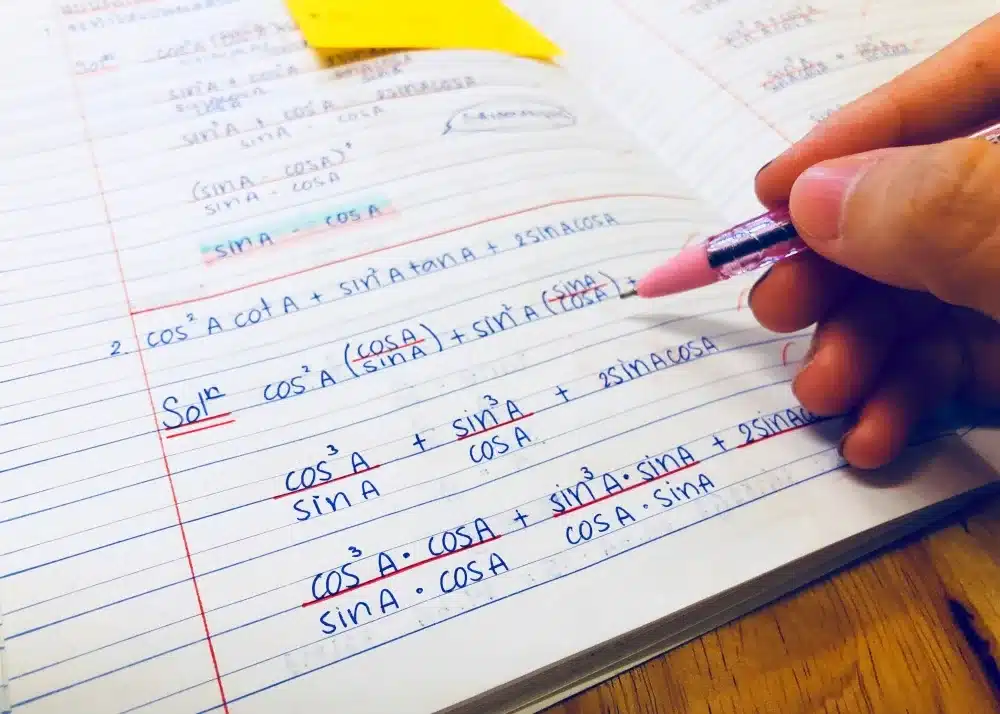
Every student sitting for the O-Level Mathematics papers receives a formula sheet with their question booklet. Most treat it as a safety net. A few treat it as a working tool. The difference probably shows up in the marks they recover during the paper.
So the real question going into your final months of revision is this: are you using the sheet, or is the sheet using up your time?
Defining the Official O-Level Mathematics Reference Documents
The formula sheets issued by SEAB during the 4052 (E-Math) and 4049 (A-Math) papers are official summary sheets attached to the question booklet on the day of the exam. They are not the same as study aids downloaded from a random tuition site, and the version you revise with should always match the current syllabus year.
Between them, the two sheets distil concepts from algebra, geometry, trigonometry, and statistics into a compact reference. The E-Math version covers mensuration, cone and pyramid volumes, the sine and cosine rules, and statistics for grouped data, while the A-Math version extends into calculus, binomial expansions, and a longer list of trigonometric identities.
The sheets are only effective, however, if you understand the logic behind each variable and recognise when to apply the formula in context. In addition, a student who knows the quadratic formula is not printed on either sheet will prepare for it during revision, while a student who assumes everything will be available in the exam hall risks freezing when it is not.
Why These Reference Sheets are More Critical Today
Part of the reason this awareness and preparation matter is that the sheet has a different role now than it did a decade ago. The way O-Level Maths is assessed has shifted, and three forces in particular make the formula sheet more central to how the paper is answered.
- Application-Based Testing: Math exam papers today ask you to solve problems set in real-world contexts such as money, measurement, and rates, which means the task becomes identifying which formula applies rather than performing a calculation in isolation.
- Reduced Cognitive Overload: With the sheet available, your working memory does not have to hold every constant and identity, which frees you to focus on the higher-order reasoning where more marks now sit.
- Building Numeracy Confidence: Regular work with the sheet during revision bridges the gap between abstract algebra and practical calculations like compound interest or percentage change.
Navigating the GCE Ordinary Level (4052) Mathematics Content
The E-Math formula sheet is practical in focus, covering mensuration, trigonometry in the form of sine and cosine rules, and statistical measures for grouped data.
So, if you are preparing for 4052, spend revision time learning where each formula sits on the page, because any time lost flipping between the question and the sheet is time you cannot use to solve the problem.
The more important point is what the sheet does not include. Several foundational formulas are expected knowledge, not reference material:
- Quadratic formula
- Pythagorean theorem
- Standard algebraic identities
Students who lean on the sheet for everything find themselves short during the paper, because the formulas they need most often are the ones they have to recall from memory.
Examining the Additional Mathematics (4049) Formula List
The A-Math formula sheet is denser and more abstract. It contains binomial expansions, standard results for differentiation and integration, and a wider set of trigonometric identities.
Topic | E-Math (4052) sheet | A-Math (4049) sheet |
Mensuration | Yes | No |
Sine and cosine rules | Yes | Yes |
Double-angle and addition formulas | No | Yes |
Standard differentiation and integration | No | Yes |
Binomial expansion | No | Yes |
Statistics for grouped data | Yes | No |
If you are taking A-Math, the real skill is identity selection, not formula recall. Knowing which identity applies to a given factorisation or proof is what earns marks. The sheet supports that skill but does not replace it.
Comprehensive Breakdown of Essential O-Level Mathematical Formulas
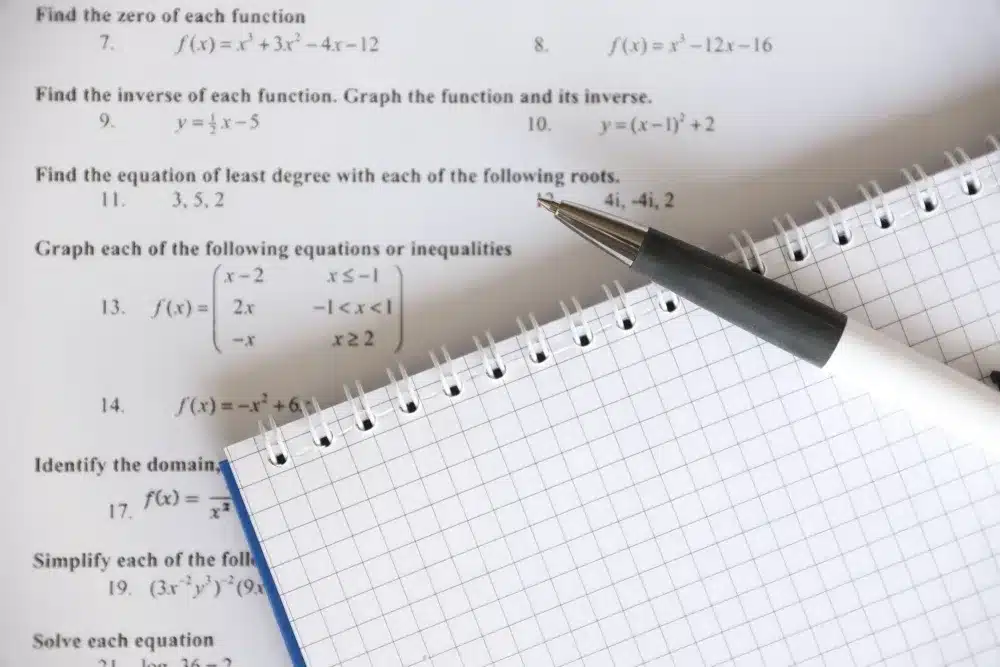
Some formulas appear on the sheets. Others you are expected to know by heart. Some of these include:
1. Algebraic Foundations
Commit these to memory before the exam:
- (a + b)² = a² + 2ab + b²
- (a − b)² = a² − 2ab + b²
- (a + b)(a − b) = a² − b²
- Quadratic formula: x = (−b ± √(b² − 4ac)) / 2a
2. Percentages and Financial Math
These formulas appear frequently in application-based questions and are not always printed on the sheet:
- Percentage Change: ((new value − original value) / original value) × 100%
- Discount: marked price × (1 − discount rate)
- Simple Interest: principal × rate × time
- Compound Interest: principal × (1 + rate)ⁿ, where n is the number of period
3. Rate, Distance, and Velocity
- Speed = distance ÷ time
- Distance = speed × time
- Time = distance ÷ speed
- Average speed = total distance travelled ÷ total time taken
Common mistake to avoid: average speed is the total distance divided by the total time, not the average of two speeds. Questions that give you two legs of a journey with different speeds are specifically testing whether you know this.
How to Utilise Your Formula Sheets with Maximum Efficiency
But of course, knowing a formula sits somewhere on the sheet does not help when you are midway through Paper 2, the clock is moving, and you cannot remember which column it is in. The habits below can help turn things around in those moments:
- Retrieval Drill: Keep the formula sheet visible during every study session, not just the week before the exam. Over time, you build a mental map of where each formula lives, which means less time searching and more time solving in the exam hall.
- Personalised Annotation: During revision, add short worked examples next to formulas or colour-code them by topic. The sheet in the exam is clean, but the one you revise with should be marked up.
- Blind Practice: Alternate between solving problems with the sheet visible and solving them from memory. This is how long-term retention builds.
- Unit Awareness: Before writing your final answer, check whether the question specifies units. If it does not, use the formula sheet to confirm you have not missed a conversion step, particularly in mensuration and rate problems.
Turn Your Formula Sheet into a Power Tool with TLS Tutorials
The O-Level Math formula sheet is only as useful as the student using it. Having the sheet in front of you does not build the judgment to know which formula applies to a given question, and that judgment is what the paper actually tests.
At TLS Tutorials, we work with Secondary 4 students to close that gap. Our educators diagnose where a student’s understanding breaks down, then structure lessons around those specific weaknesses. With a maximum of four students per class, the feedback is specific to their needs.
If you are looking for a tuition centre in Singapore that offers Maths tuition for Secondary 4 students built on targeted diagnosis rather than volume practice, enrol in a free trial lesson to see our approach in action.