

Navigating the 2026 PSLE Math Paper 1 & 2: Avoiding the 2-Mark Trap and Common Pitfalls
- 7 min read
The 2026 PSLE Maths paper has changed in a way that affects how every student should approach Paper 1 and Paper 2. For parents, the concern is not just whether the syllabus has changed, but whether their child’s usual exam habits still work under the updated structure.
The key change is in the short-answer sections. Under the previous format, Booklet B carried a mix: five questions worth 1 mark each and ten worth 2 marks. Under the new format, those 1-mark questions are gone. All 12 short-answer questions in Booklet B now carry 2 marks, and the same applies to the five short-answer questions in Paper 2.
This creates what many students may experience as the 2-mark trap. A child may solve a question mentally, write only the final answer, and move on. If the answer is correct, there is no issue. If a careless slip happens, there may be no working for the marker to credit. That means a mistake that once would have been minor can now cost more.
So what does this mean for the way students should approach the Math PSLE paper, and where do marks usually slip away?
The Modern Approach: How the Primary Maths Curriculum Has Evolved
Primary Maths today looks different from what most students studied in school, even though the topics appear broadly the same. The current syllabus places the emphasis on application and reasoning, assessing whether students can work through a problem they have not seen before and adapt what they know to how a question is framed.
The pedagogy that underpins this starts at the Lower Primary level. Students begin with concrete objects, move to visual representations like the model method, then work up to abstract algebraic thinking. The Concrete-Pictorial-Abstract approach deepens understanding at each stage, so students are reasoning through problems rather than matching them to memorised procedures.
This is where many Primary 6 students feel the pressure.
A child may understand the topic during revision, but freeze when the question looks different from the examples they practised. For instance, a percentage question may be combined with a comparison. A geometry question may require students to connect diagram clues before choosing a method. A word problem may require careful reading before any calculation begins. Only a student who genuinely understands the reasoning behind each concept can adapt when a question shifts direction in these ways.
Behind the Scenes: How the PSLE Maths Paper is Designed and Marked
The PSLE Maths paper assesses different levels of mathematical thinking. Some questions test straightforward computation and basic concepts. Others require students to interpret information, apply concepts in context, and reason through multi-step problems. And of these, a small percentage of the total marks tend to come from questions designed to differentiate top performers. The remainder is accessible to any student who has covered the syllabus.
One detail that surprises many parents: there is no fixed method for solving a PSLE Maths question. As long as the concept is applied correctly and working is shown clearly, a student is credited for their method even if the final answer is wrong. A student who skips working has no fallback when that answer is incorrect.
The 2-Mark Short-Answer Shift: Why Precision is Now Compulsory
The updated PSLE Math Paper 1 duration is now 1 hour 10 minutes and carries 50 marks. Paper 2 runs for 1 hour 20 minutes and carries 50 marks. The combined total stays at 100.
Inside Paper 1, the key update is in Booklet B. The previous format included five 1-mark short-answer questions alongside ten 2-mark ones. In 2026, those five 1-mark questions are gone. Booklet B now contains 12 short-answer questions, all carrying 2 marks each.
The scoring rules for short-answer questions are unchanged:
- For two-part questions, 2 marks are awarded for correct answers, one mark for each correct part.
- For single-part questions, 2 marks are awarded for the correct answer.
- If an incorrect answer is given, 1 mark is awarded for the correct method.
The trap sits in that last condition.
A student who solves a question mentally and writes only the answer receives zero marks if that answer is incorrect. In addition, partial working that does not clearly lead to a solution no longer qualifies for a pity mark.
Under the older format, a careless slip cost one mark. Under the new format, the same slip can cost two.
Careless Errors: The Silent Score Killers
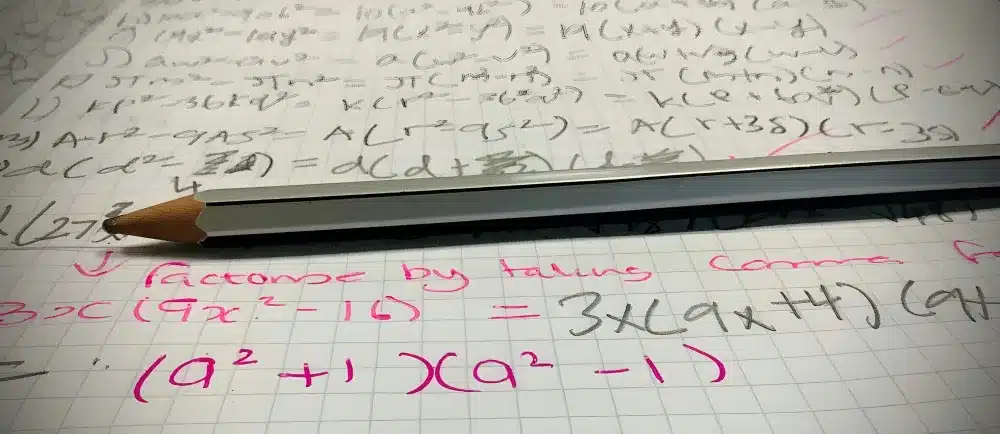
The format change removes the 1-mark questions from Booklet B, but marks are still lost for reasons beyond paper structure. As mentioned, a student can know the topic and still lose marks through execution errors unrelated to understanding.
1. Incorrect Copying of Numbers
A student can understand exactly how to approach a question and still copy a 7 from the question paper as a 1 onto their working space. Every step that follows is based on the wrong number, and the error compounds across the entire solution.
- Solution: Underline the key numbers in each question before beginning. Check them against your working before writing the first step.
2. Misreading Questions
Words like “not,” “incorrect,” and “remaining” change the demand of the question completely, but they are easy to skim over under time pressure. A student who answers the question they thought they read produces a full solution, working shown, for zero marks.
- Solution: Read each question twice before starting. Underline the core demand and rephrase it in your own words to confirm the context has been understood.
3. Errors in Calculation
Arithmetic errors derail higher-mark questions just as easily as conceptual ones. A small slip in multiplication at step two can invalidate every step that follows.
- Solution: Break complex calculations into smaller steps and use estimation as a final check. An answer of 5kg for the mass of a pencil is wrong before any rechecking is needed.
How to Improve and Achieve Exam Success
The 2026 format rewards students who work methodically. Three habits address the specific risks it introduces:
- Analyse every mistake by category: Was it a conceptual gap or an execution slip? The two require different responses, and treating them the same wastes revision time.
- Practise under timed conditions: Exam stamina comes from work with a clock running, not from completing papers at a comfortable pace.
- Treat accuracy as more important than speed: Finishing the paper quickly with three careless errors costs more than finishing slightly slower with none.
Avoiding the 2-mark trap is not about working faster. It is about working with a structure that protects partial credit when something goes wrong. At TLS Tutorials, our PSLE Math tuition programme begins with a diagnostic assessment that pinpoints where each student is losing marks, and lessons are focused on those specific patterns. If you are looking at Primary Math tuition in Singapore for your child this year, speak with us to find out how we prepare students for the new paper format.