

Beyond the Red Cross: How to Learn from Exam Mistakes to Boost Performance
- 7 min read

After a test, most parents look at the score, sign the paper, and have their kid put it back into their files. The instinct is to note the result and move on, often by having their child work on more practice papers. The red crosses rarely get a closer look.
The problem with such a response is that more practice does not fix the core reason behind why marks were lost in a test or exam in the first place. A student who works through ten more papers without reviewing the errors from the last one is not closing gaps. They are simply practising the same mistakes under different question numbers.
The Hidden Value of Making Errors
When a student gets everything right during practice, it can finally feel like all the hard work is paying off. But correct answers during revision confirm what the student already knows, not what still needs attention before a major examination like the PSLE or O-Levels.
Cognitive psychology research has documented a pattern known as the generation effect: when a student produces an answer, even an incorrect one, and then receives a clear correction, the brain retains that information more than if they had simply read the right answer. This means that getting something wrong, then learning why, strengthens the correction in a way that passive reading does not.
The Diagnostic Method: How to Properly Review a Wrong Answer
Knowing that mistakes have learning value is one step, but knowing what to do with them is what changes results. Most students are told to “learn from their mistakes,” but without a method for reviewing what went wrong, that advice does not lead anywhere.
A practical starting point is to classify every wrong answer into one of three categories:
- Concept Gap: The student did not understand the underlying topic or method. For example, applying the wrong formula in a Maths question because the reasoning behind it was never fully understood.
- Application Gap: The student understood the concept and the question, but could not work out how to apply a solution to it. This is common in PSLE Maths and O-Level Science papers, where familiar concepts appear in unfamiliar contexts.
- Interpretation Gap: The student could not identify what the question was actually asking, either missing the logical structure of the problem or failing to connect it to the right topic or concept.
- Careless Error: A misread, a skipped step, or a calculation slip caused by rushing or fatigue.
Each category requires a different fix. For instance, concept gaps need re-teaching before further practice. Application gaps need exposure to a wider range of question formats. Careless errors need adjustments to how the student works through papers, not more of it.
4 Steps to a Productive Review
Once the common exam mistakes have been classified, these four steps are what separate reviewing a paper from learning from it:
- Keep a Mistake Log by Topic and Error Category: Over a few weeks, patterns may surface that show which areas are costing the most marks.
- Analyse Why the Reasoning Broke Down: Trace back to the exact step where the logic went off track, and identify whether the issue was conceptual, application-based, or careless.
- Re-Check Before Marking: After completing a practice paper, re-read answers before comparing them to the mark scheme. This builds the habit of self-correction.
- Test Before Revising: Attempt questions on a topic before re-reading the notes. This exposes where understanding has broken down, not just where it feels shaky.
Common Exam Mistake 1: Rushing Through the Paper
Under exam pressure, students often speed through questions without fully reading through them. Keywords get missed, steps in working get skipped, and marks are lost on questions that the student probably practised multiple times and knew how to answer.
What is the Best Way to Correct this Mistake?
Read each question carefully, even when it feels like the clock is against you. If anxiety builds, pause for a few seconds before moving on. Those seconds cost far less than the marks lost by rushing through the next question.
Common Exam Mistake 2: Poor Time Management
A student who spends fifteen minutes on a single five-mark question may only have ten minutes left for the remaining twenty marks. Under exam conditions, students lose track of time when a difficult question creates the urge to keep working on it until it is solved.
What is the Best Way to Correct this Mistake?
Allocate a rough time limit for each section based on the marks available before starting. If a question is taking significantly longer than expected, move on and return to it after the more straightforward questions have been completed.
Common Exam Mistake 3: Misinterpreting Questions and Qualifiers
Students often scan a question for topic-related keywords and miss the qualifying words that change what the question is actually asking. Words like “not,” “except,” “always,” and “describe” each require a different type of answer, and missing one can lead to a response that does not address what the examiner is looking for.
What is the Best Way to Correct this Mistake?
Read the question twice. On the second reading, underline or circle qualifying words. This is especially relevant in Science papers, where a single qualifier can shift the question from factual recall to applied reasoning.
Common Exam Mistake 4: Saving the Simple Questions for Last
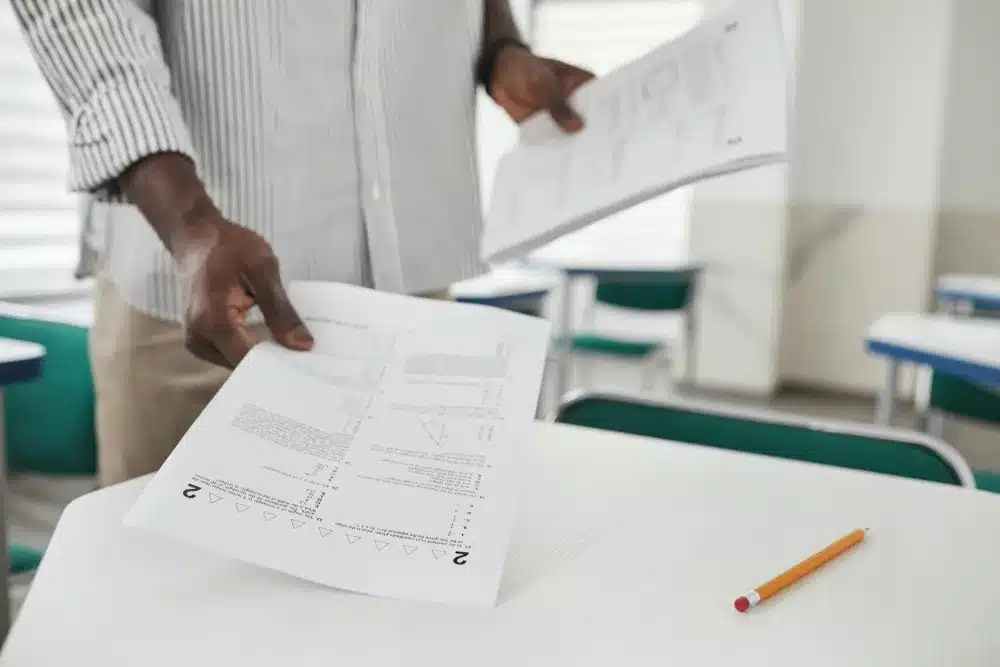
Some students prefer to tackle the hardest questions first, thinking that these tend to carry the most marks. But spending a large portion of time during an exam only working on the difficult problems often means running out of time before reaching questions they could have answered with ease.
What is the Best Way to Correct this Mistake?
Work through the questions you are most confident about first. Securing those marks early builds momentum and frees up remaining time for the more demanding sections.
Common Exam Mistake 5: Neglecting Sectional Instructions and Mark Allocation
Students sometimes write their answers without checking how many marks a question carries or what the instructions specifically ask for. For example, a student who writes a full paragraph for a one-mark “state” question wastes time. On the other hand, a student who gives a one-line answer to a four-mark “explain” question leaves marks on the table.
What is the Best Way to Correct this Mistake?
Check the marks assigned to each question before writing and match the level of detail to the marks that might be awarded. Underline the action word in the question, whether it says “list,” “explain,” “describe,” or “calculate,” so your answer format matches what the examiner expects.
Learning from Exam Mistakes: A Growth Mindset
Real progress comes from working at the edge of your current ability, where mistakes are expected and examined as part of the revision.
At TLS Tutorials, our educators use diagnostic testing to pinpoint where understanding breaks down, then structure each lesson around those specific gaps. Whether you are looking for Primary Maths tuition, Secondary Maths tuition, or Secondary Science tuition for your child, the approach at our tuition centre is the same: identify where marks are being lost, understand why, and address the root cause.
If your child keeps making the same mistakes despite putting in the hours, speak with us about how our diagnostic assessment can change the direction of their revision.