Primary 6 is the checkpoint that the rest of primary school has been leading to. The PSLE helps guide secondary school placement and subject pathways, and can shape a child’s confidence in the subject moving forward.
As per the updated MOE syllabus, students are expected to handle topics such as Algebra and Ratio with a stronger conceptual understanding, making focused, up-to-date preparation more important than ever.
At TLS Tutorials, our PSLE Maths tuition is designed for this. We teach through our meta-cognitive learning approach, in which students learn to plan a solution, monitor their own work, and reflect on what a model answer looks like.
For a P6 student, this means walking into the exam hall not just knowing the content but also knowing how to apply it under pressure.
Through our programme, your child will:

Primary 6 raises the bar in a way no earlier year does. Questions no longer test a single concept in isolation. They require students to connect multiple concepts and reward those who can move between ideas fluently rather than recite a method.
For many students, this is the first time memorisation stops paying off, and the shift shows up as a quiet dip in marks.
A single PSLE question might combine ratio and percentage, or algebra and area, in ways that reward flexible thinking over formula recall. Children who learn each topic separately can freeze when the links between concepts are unclear.
Algebra is the biggest addition to the updated P6 syllabus, and your child meets letters-as-unknowns for the first time. Without a clear bridge from arithmetic, forming expressions and solving simple linear equations can feel arbitrary.
P6 is a national examination year. Beyond the content, children are navigating time pressure, a two-paper structure, and the weight of a result that affects secondary school placement.
What most P6 students need is not more questions, but a tutor who teaches them how to read the question, choose the right approach, and check their own thinking before the bell.
At TLS Tutorials, our Primary School Math students are guided to apply concepts step by step and approach problem sums with clarity and accuracy instead of relying on guesswork.
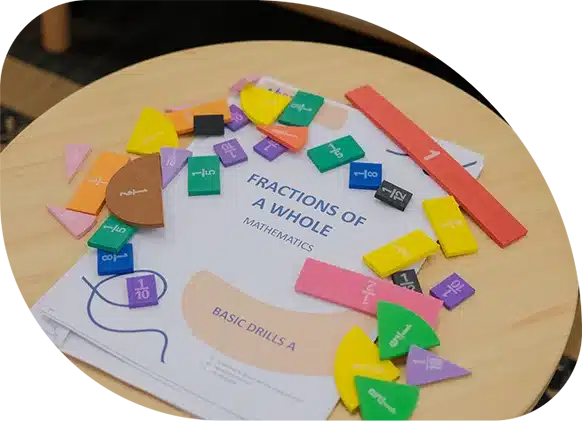
Students reinforce key topics such as fractions, percentages, and ratios through direct question formats. This stage ensures they can apply methods correctly and minimise errors before moving into more demanding problem sums.
Students work on multi-step questions that require combining topics and interpreting more complex problem scenarios. They learn to identify key information, select the correct methods, and carry out each step accurately across different question formats.
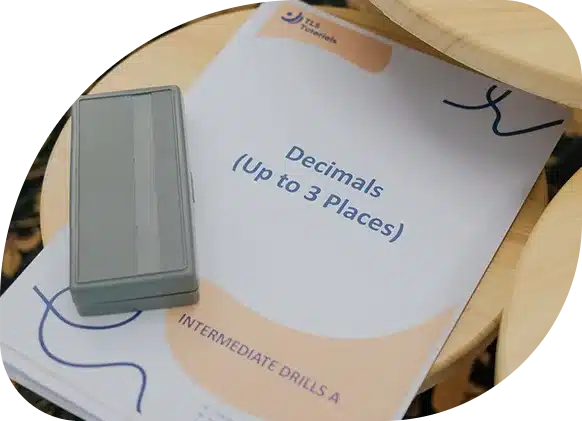
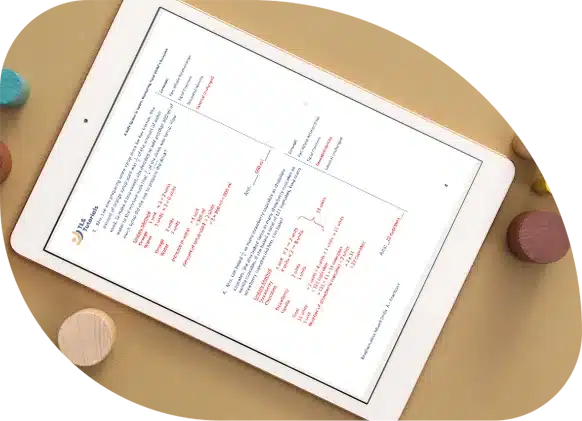
Students are trained to handle higher-order problem sums commonly seen in PSLE papers. They learn to adapt their approach, apply the right strategies efficiently, and present complete answers with all required steps and key phrases.
Our Primary 6 Math programme prepares students to manage PSLE demands with accuracy, consistency, and effective exam handling.
Focus Area | How We Develop It |
|---|---|
Skills We Develop | Students are trained to interpret complex problem sums, identify what is being tested, and apply the correct concepts. Emphasis is placed on presenting clear workings to secure marks and handling unfamiliar questions using appropriate strategies. |
How Lessons Are Run | Lessons focus on guided practice followed by independent work. Students learn to identify key information, organise their steps clearly, and refine their methods through targeted feedback focused on accuracy and efficiency. |
Examination Alignment | Our programme is aligned with PSLE Math formats. Students are trained to recognise common question types, avoid frequent mistakes, and complete timed practices to improve performance under exam conditions. |
See how TLS Tutorial’s tuition programme has made a meaningful difference for both P6 Maths students and parents.
Trustindex verifies that the original source of the review is Google. I joined TLS quite late in the school year. Roughly around 5 months before my O level exams. At first, I was only doing physics with Mrs Esther, however, after 2 weeks with her, I had made the decision to do chemistry lessons with TLS as well. When I first went in, I was very worried because my chemistry and my physics were sub-par at best and was nervous that I wouldn’t be able to learn and prepare all I would need in time for my o levels. I was wrong. Firstly, the environment that TLS creates for students to work is amazing. It’s calm, quiet and allows us to easily focus on whatever we are doing. Moreover, the teachers at TLS are exceptionally nice and supportive people that give you the time patience and understanding that you need. Secondly, to do with the tutorials itself, not only are the tutors very kind, but they are very thorough and extensive in helping us understand what we are lacking and what we require help with. Their materials are amazing and they also made a very enjoyable experience to simply be in the classroom and learn. Besides academics however, TLS also does a wonderful job at ensuring we stay organised and on top of our work, with a comprehensive study plan as well as many files and binders to neatly keep or work in. I saw that this truly helped my studying and my academics as generally, I am a very messy and disorganised person. Overall, TLS has been able to help me in multiple ways. Within the span of four months, I was able to catch up on everything I was missing, they helped me start scoring better gradually as I continued to do mock test papers, and with their help, I was able to stay on top of everything with wonderful organisation and amazing planning done by the admin team. The centre is filled with amazing teachers, with their teaching being top-notch and their kindness and care for our well being also being a priority to them. Thanks to TLS, my physics and chemistry grades rose from a D7 and F9 in prelims to an A2 and B3 in the o levels, respectively. My sincere thank you to the entire TLS team and a special thank you to Mrs Esther for her dedication and support for my o levels.Trustindex verifies that the original source of the review is Google. amazing tuition centre with perfect vibes and an amazing awesome teacher who coached me in amathTrustindex verifies that the original source of the review is Google. Ms Winnie is a nice and understanding teacherTrustindex verifies that the original source of the review is Google. Started here in P4 Math, grade has remained consistent at A*. Continued with TLS academy until sec 4 . O Level A Math grade was A1. Teachers here are kind and understanding, they are adaptable and are able to adapt their teaching style to help me with understanding content. Would highly recommend people to join their classes.Trustindex verifies that the original source of the review is Google. My P6 daughter started math tuition at TLS this year and enjoys coming to class each week. She says this is her favourite tuition class. Ms Esther and Abel have periodically run diagnostics tests on her math abilities which really help in identifying the areas where she needs to work on. I see her math grades improving and am hopeful she will do well in the PSLE.Trustindex verifies that the original source of the review is Google. Mrs Esther is extremely patient and caring, I went from a 46% to a 87% in less than 5 months! The centre is very accommodating and I would highly recommendTrustindex verifies that the original source of the review is Google. My daughter enjoys her lessons at TLS Tutorials which is specifically tailored to her syllabus based on her needs by Teacher Esther. The class is small, personable and conducive for learning and interaction with the teacher. The learning experience coupled with the very warm and supportive TLS team make us feel welcome right from the start !Trustindex verifies that the original source of the review is Google. good tutors that teach well 👍🏻Trustindex verifies that the original source of the review is Google. I couldn’t recommend them more highly. Most tuition centres are about revision, homework and test preparation TLS does that and more; they have monthly diagnostics test and check ins with the parents which is helpful for us to understand our children’s progress. Most importantly through these interactions, you feel they truly have the heart for your kids not just academically but also for their well being !Trustindex verifies that the original source of the review is Google. We've seen a complete transformation in our daughters' attitude towards Maths since they started tuition here! They now look forward to their Maths lessons, which is a testament to the engaging and effective teaching methods used. We're grateful for Ms Giana's dedication and passion for teaching Maths and Abel's passion for caring for the students. Highly recommend!
At TLS Tutorials, we equip your child with the strategies, precision, and exam confidence needed to excel in the PSLE, ensuring they enter secondary school fully prepared.
With no more than 4 students in the room, your child’s progress is checked in real time, and their specific weak points are addressed in the same lesson they appear.
Our centre and tutors are registered with MOE. Teaching materials are aligned to the current Primary Maths syllabus for P6.
Our tuition centre is within walking distance of the Newton MRT station, with easy access by bus and car from across the central region. No long commutes eat into revision time.
Your child is taught to think about their own thinking, which is exactly the skill the updated PSLE paper rewards through its structured-question format.
Timed mock papers, past-year analysis, and topic-by-topic diagnostic tracking are built into every term, so nothing about the exam format comes as a surprise on paper day.
Fractions + Ratio Foundations
Advanced Ratio + Percentage
Algebra + Geometry (Angles)
Circles + Volume + Data Analysis + Integration
We sequence topics so each one strengthens the next. Fractions come first because ratios, percentages and algebra all lean on fluent fraction work. Circles are taught early to give your child plenty of time to revisit pi-based calculation throughout the year. Algebra anchors the final term because it ties together everything taught before.
These are the skills and techniques that your child will develop when you enrol them in our Primary 6 Maths Tuition:
Gain confidence in adding, subtracting, multiplying, and dividing proper and improper fractions to handle various fraction-based problem types with accuracy and speed.
Learn to calculate percentage increases, decreases, and parts of a whole. Strengthen the ability to solve questions involving discounts, interest, and percentage change across both academic and real-life contexts.
Understand how to simplify ratios, solve part-whole relationships, and find missing terms in equivalent ratios. These are key concepts that are heavily tested in word problems requiring strong analytical and proportional reasoning.
Form and simplify algebraic expressions, substitute values, and solve simple equations. This will build students’ confidence in using symbols and unknowns to approach problems logically.
Tackle questions involving the area of composite shapes and calculate the volume of cuboids and cubes, including problems that require finding unknown dimensions.
Learn to calculate averages and draw insights from data sets presented in visual formats like tables or graphs.
Apply angle properties of special quadrilaterals to find unknown angles in composite figures. Strengthen spatial reasoning and geometry skills for questions involving trapeziums, parallelograms, rhombuses, and more.
Monday – Friday
10AM – 7PM
Saturday
9AM – 6PM
Closed on Sundays and Public Holidays
Through a nurturing and supportive learning environment, we help P6 students overcome gaps, build confidence, and perform at their best in PSLE Maths.
At TLS Tutorials, we use a meta-cognitive learning approach to help primary 6 students learn Maths more effectively. It involves a mastery approach: Basic, Intermediate, and Advanced. At each stage, our tutor coaches your child’s thinking process, not just the final answer, so the reasoning transfers to unfamiliar PSLE questions.
Unfortunately, we don't offer online tuition lessons for Primary 6 Maths. All our classes are conducted in person at our tuition centre, located at 10 Winstedt Road, Block A #02-04, Singapore 227977. This allows us to provide focused, hands-on support in a classroom setting where students can stay engaged and receive real-time guidance from our tutors.
Our P6 Maths tuition fees are competitively priced and reflect the quality of instruction, personalised support, and PSLE-focused guidance we provide. You can contact us at +65 8803 6858 or email us for specific pricing details. Students are also welcome to sign up for a free trial class to see if our PSLE Maths tuition suits their learning style and academic needs.
Yes, it is worth getting a tutor for Primary 6 Maths. PSLE Maths tests key topics like Algebra, Ratio, and Average at P6 level, and school pacing often cannot address individual gaps. Targeted tuition helps close these gaps early and builds the exam skills needed to achieve top AL scores.
Our P6 Maths tuition classes are capped at 4 students, with an optimal size of 3. Each lesson runs for 2 hours (including a 10-minute break), with 4 in-person lessons per month to support consistent progress.
Yes. Our P6 Maths curriculum follows the MOE Primary Maths Syllabus, covering Fractions, Circles, Ratio, Volume of Cube and Cuboid, Percentage, Average, Angles in Geometric Figures and Algebra.
Yes, your child can attend one complimentary 120-minute on-site trial session for P6 Maths before making any final commitment.
Explore our full range of Math tuition programmes.

TLS Tutorials is an MOE-registered tuition centre in Singapore providing Math & Science programmes for Primary and Secondary school students. Located near Newton MRT, we offer a supportive learning environment.
10 Winstedt Road, Block A #02-04 / #02-08
Singapore 227977
Subscribe
Subscribe to our newsletter to get updated on the latest resources, news and promotion.
© 2026 TLS Tutorial Centre Pte. Ltd.