

Mastering the Periodic Table of Elements for O-Level: The Foundation of Chemical Success
- 7 min read
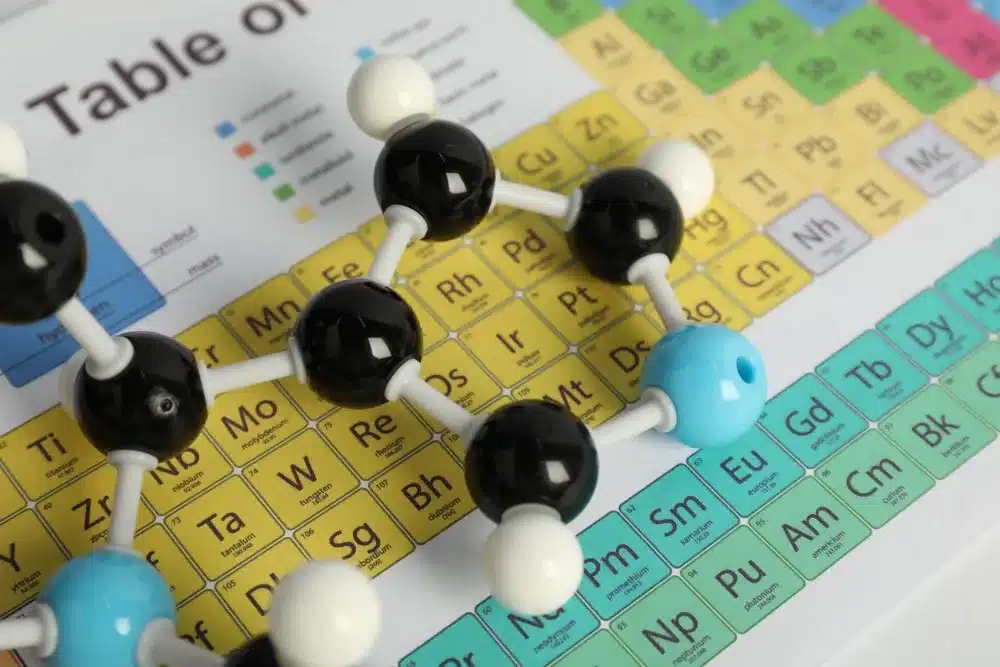
The periodic table of elements is the most used reference in Chemistry. Every reaction, every bond, every calculation traces back to it. During the O-Levels, the table is printed on the exam paper itself, which means students are not expected to memorise it. They are expected to use it.
That distinction shapes how revision should work. The table contains atomic numbers, mass numbers, group positions, and period positions, each connecting to a different area of the syllabus: bonding, reactivity, stoichiometry, acids and bases, and even the behaviour of transition metals.
But why is the periodic table important to students?
A student who knows how to extract the right information from it and apply it under timed conditions will be able to benefit from it, especially in terms of making fewer errors across multiple question types.
The Evolution of the Chemical Map
The modern periodic table is built on over a century of refinement. Early versions, most notably Mendeleev’s arrangement in 1869, grouped elements by atomic mass and chemical behaviour. The structure was so precise that Mendeleev left deliberate gaps for elements that had not yet been discovered, and predicted their properties accurately. Gallium and germanium, discovered years later, matched his predictions closely.
Today’s version arranges elements by atomic number instead of mass. This corrected several placement errors in the original table, such as tellurium and iodine, which Mendeleev had to swap manually because their masses did not match their chemical behaviour. Ordering by proton count resolved the contradiction entirely.
Decoding the Periodic Table: Navigating the Table’s Architecture
Each feature of the periodic table, from atomic number to group position to periodic trends, connects to specific O-Level topics.
1. The Atomic Number and Mass
Each element box contains two numbers. The atomic number (the smaller one) indicates the number of protons in the nucleus, which also equals the number of electrons in a neutral atom. This number determines the element’s identity and its position in the table.
Elements are grouped by their chemical behaviour:
- Group 1: Alkali metals
- Group 17: Halogens
- Group 18: Noble gases
The mass number (the larger figure) represents the total of protons and neutrons. This is the number used in stoichiometric calculations to determine relative atomic mass and reacting masses.
2. Vertical Groups and Horizontal Periods
- Groups (columns): Organises elements by the number of valence electrons. Elements within the same group share similar chemical properties and form ions with the same charge. Group 1 elements all form +1 ions. Group 17 elements all form -1 ions.
- Periods (rows): Corresponds to the number of electron shells. Moving across a period, elements shift from metallic to non-metallic character, which directly affects their bonding behaviour and reactivity.
3. Three Elemental Characteristics
The table divides elements into three broad categories: metals on the left, non-metals on the right, and metalloids along the zigzag boundary between them.
An element’s position also indicates its likely physical state at room temperature. Sodium, for example, is a soft, low-melting-point metal, while iron has a much higher melting point and sits further along the transition metal block. Among non-metals, oxygen and nitrogen are gases at room temperature, while sulfur is a solid. These distinctions come up regularly in questions that ask students to compare or classify elements.
4. Bonds and Molecular Interactions
Group position indicates how an element is likely to bond.
- Elements on the far left (Groups 1 and 2) tend to lose electrons and form ionic bonds with non-metals.
- Elements on the right (Groups 15 to 17) tend to gain or share electrons, forming covalent bonds.
This grouping supports dot-and-cross diagrams and electronic configurations, both of which are tested regularly at O-Level.
4. Reactivity and Combining Power
Valency (an element’s bonding capacity) follows directly from group number:
- Group 1: valency of 1
- Group 2: valency of 2
- Group 17: valency of 1 (needs one electron to complete the outer shell)
This feeds into balancing chemical equations and predicting the formulas of compounds. Reactivity also follows from group position. Elements with low ionisation energies, such as those in Group 1, lose their outer electron easily and react readily. Elements with stable, fully filled configurations (Group 18) are largely inert.
5. Acids, Bases, and Salts
Once you know whether an element is a metal or non-metal, you can predict the nature of its oxide: metallic oxides are basic, non-metallic oxides are acidic. This connects directly to predicting salt formation, writing ionic equations, and working through neutralisation reactions, all of which are high-frequency O-Level topics.
6. Transition Metals
Beyond the main group elements, the central block contains the transition metals, which behave differently in several ways. They can form more than one type of ion. Iron, for example, can exist as Fe²⁺ or Fe³⁺, each producing compounds with different properties.
Transition metals are also characterised by high density, high melting points, the ability to form coloured compounds, and catalytic activity. And we all know how O-Level questions often test whether students can distinguish their behaviour from that of Group 1 or Group 2 metals.
7. Noble Gases
At the opposite end of the reactivity spectrum, Group 18 elements have fully filled valence shells, making them extremely stable and unreactive. They exist as monatomic gases under standard conditions.
Their stability has practical applications: helium is used in balloons because it is non-flammable, and argon is used in lightbulbs to prevent filament oxidation. These real-world examples occasionally appear in O-Level application questions.
Identify Key Periodic Patterns

Once you have navigated to your elements, you apply periodic trends to explain their relationship. When comparing elements or explaining differences in reactivity, there are two key trends to know:
- Atomic radius decreases across a period (as nuclear charge increases, electrons are pulled closer to the nucleus) and increases down a group (as more electron shells are added)
- Electronegativity increases across a period and decreases down a group, following the inverse pattern of atomic radius
For students, these trends answer a specific type of exam question: why one element is more reactive, or forms stronger bonds, than another. A question comparing the reactivity of lithium and potassium, for example, is answered by the trend in atomic radius down Group 1.
Strategic Utility in Predicting Chemical Transformations
The periodic table ties directly into quantitative Chemistry. In practice, students rely on it for three things:
- Extracting relative atomic masses to calculate reacting masses and molar ratios
- Determining the formulas of compounds when writing and balancing chemical equations
- Predicting the products of a reaction based on the reactivity and bonding tendencies of the elements involved
Secondary school students who can move between the table and their calculations without hesitation will be able to complete stoichiometry questions faster and with fewer errors under timed conditions.
Secure Your Chemistry Mastery with TLS Tutorials
The periodic table appears on every O-Level Chemistry paper for a reason. The difference between students who use it well and those who do not often comes down to whether they have been taught to read it as a connected system or as a list of isolated facts.
At TLS Tutorials, our educators teach students how to extract and apply information from the table across every major topic in the syllabus. If your child is finding it difficult to connect concepts across chapters, a teaching approach built around their specific gaps can close them. As a Chemistry tuition centre in Singapore, we build each lesson around the areas where understanding breaks down. Speak with us to find out how our Secondary School Science tuition programme can support your child’s O-Level preparation.